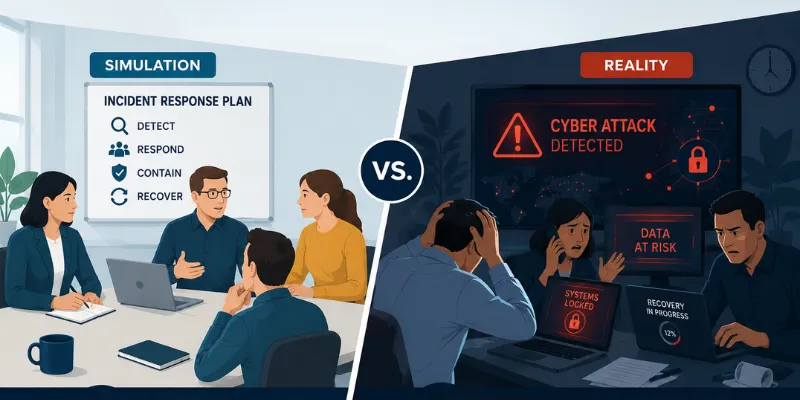
Simulation vs. Reality: Why Practicing Cyber Drills Prepares You for the Real Thing
Article Summary: Cybersecurity training isn’t just about checking a box. Business leaders can reduce panic, improve response times, and protect client trust through realistic cyber drills and hands-on simulations.
Most business owners assume they’ll figure things out when a cyber incident happens.
That feels reasonable until the pressure becomes real.
An employee clicks a suspicious link. Files suddenly stop opening. Phones start ringing. Someone notices strange activity in a shared folder, and within minutes, the entire office feels tense. People start looking around for answers while the clock keeps moving.
That’s usually how cyber incidents unfold. Fast, confusing, and stressful.
Here’s the part many businesses underestimate: technology alone doesn’t determine how well you respond. Your people do. That’s why cybersecurity drills matter.
If pilots never trained in simulators or emergency medical teams never rehearsed high-pressure situations, we’d call that reckless, not brave. Yet many businesses approach cybersecurity the same way. They wait until a real incident happens before discovering whether their team actually knows what to do. By then, it’s already chaos.
The businesses that handle cyber incidents best usually aren’t the ones with the flashiest tools. They’re the ones that practiced before something went wrong. They’ve walked through the process, clarified responsibilities, and built confidence long before the pressure hit. That preparation changes everything.
Why Cyber Incidents Feel So Overwhelming
Cyberattacks move quickly, and they rarely announce themselves in obvious ways.
A phishing email can look completely legitimate. A stolen login may appear normal at first. Ransomware often spreads quietly behind the scenes before anyone realizes there’s a problem.
For business owners across the Wasatch Front, that creates a serious challenge. Most leadership teams are already balancing growth goals, staffing concerns, compliance pressure, and nonstop operational demands. When confusion enters the picture, decision-making often slows down right when speed matters most.
We see this constantly in legal, medical, and financial organizations where trust is everything.
A law office worries about privileged client data being exposed. A medical practice worries about HIPAA compliance and patient confidence. A financial firm worries about protecting sensitive financial records and maintaining credibility with clients.
The technical issue matters, of course. But the emotional pressure hits just as hard.
That’s why preparation matters so much. You can’t eliminate every risk, but you can create a team that responds with clarity instead of panic. And honestly, that’s where real confidence comes from.
Policies Don’t Reveal What Happens Under Pressure
Most businesses already have cybersecurity policies somewhere. There’s usually a response plan, backup documentation, or a checklist explaining what should happen during an incident.
The problem is that written plans don’t always reflect reality.
On paper, the process sounds simple:
Report suspicious activity immediately
Escalate concerns to leadership
Restore systems from backup
Communicate with employees and clients
But when stress levels rise, things change quickly.
People hesitate because they don’t want to overreact. Employees assume someone else has already handled the issue. Communication becomes scattered. Leadership teams scramble to make decisions without clear information.
Sometimes businesses discover their backups aren’t configured the way they thought they were. Other times, they realize nobody clearly owns the response process.
Cyber drills expose those problems before attackers do.
That’s one of the biggest advantages of practicing regularly. Simulations reveal operational gaps, communication breakdowns, and decision-making weaknesses while the stakes are still low enough to fix them calmly. Because the truth usually comes out under pressure.
The Three Cybersecurity Drills Every Business Should Practice
The good news is that cybersecurity training doesn’t have to be overly complicated to be effective. In fact, some of the best exercises start with simple conversations.
1. Tabletop Exercises
These are guided discussions where leadership teams walk through a hypothetical cyber incident together.
For example: “What happens if ransomware locks down the file server tomorrow morning?”
The team talks through the response step by step.
Who gets notified first?
Who communicates with employees and clients?
Who makes the final decisions?
Who handles legal or compliance concerns?
These conversations often uncover confusion faster than expected, especially around communication and accountability.
2. Technical Response Drills
These exercises focus on testing your actual IT and security capabilities.
Your team practices things like:
Restoring backups
Isolating infected devices
Disabling compromised accounts
Verifying recovery timelines
A lot of businesses assume their systems will work because nobody’s tested them recently. That’s a risky assumption.
Practice builds certainty. It helps your team move faster and with far more confidence during a real incident.
3. Incident Response Simulations
These are realistic exercises designed to recreate urgency and pressure.
Examples include:
Mock phishing emails
Simulated ransomware alerts
Timed escalation drills
Internal communication testing
These exercises help employees build instinct and awareness. Instead of panicking, they learn how to slow down, recognize warning signs, and follow the process clearly.
That changes how people respond when something real happens.
Confidence Changes Everything
One thing I’ve learned over the years is that fear usually comes from uncertainty.
When people don’t know what to expect, stress takes over. That’s true in business, leadership, and cybersecurity. But repetition changes how people react.
The first time someone encounters a suspicious email, they may freeze or second-guess themselves. After practicing a few scenarios, they know exactly what steps to take and who to contact.
That confidence matters more than most businesses realize.
Cybersecurity drills aren’t just technical exercises. They’re leadership exercises too.
They help teams communicate more clearly under pressure. They create structure during chaotic moments. They reinforce accountability and reduce hesitation when fast action matters most.
And maybe most importantly, they help business owners regain a sense of control. The goal isn’t perfection. It's resilience.
Preparation Is What Builds Resilient Businesses
Cybersecurity isn’t really about fear. It’s about readiness.
The businesses that recover fastest from cyber incidents usually have one thing in common: they practiced before the crisis happened.
They trained their people. They tested their systems. They identified weaknesses early instead of discovering them during a worst-case scenario.
That preparation creates calmer responses, smarter decisions, and stronger recovery when something eventually goes wrong.
At qnectU, we spend a lot of time helping businesses reduce uncertainty around cybersecurity, compliance, and operational risk. And one of the simplest ways to improve readiness is through realistic training and simulations that prepare your team for the real world, not just theory.
👉 Click here to schedule a quick 26-minute call today, because when a cyber incident happens, preparation becomes the difference between a controlled response and complete chaos.
Article FAQs
How often should a business run cybersecurity drills?
Most businesses should run some form of cybersecurity exercise at least once or twice a year, but higher-risk industries like legal, medical, and financial organizations may benefit from quarterly drills. The goal isn’t to overwhelm your team with constant testing. It’s to build familiarity and confidence so employees know how to respond when something feels suspicious. Even a simple tabletop exercise can uncover communication gaps and response issues before they become real problems.
What’s the difference between cybersecurity training and a cyber drill?
Cybersecurity training teaches employees what threats look like and how to avoid common mistakes like phishing scams or weak passwords. A cyber drill goes a step further by simulating a real incident and testing how your team responds under pressure. Training builds awareness. Drills build readiness. When businesses combine both, employees are much more likely to stay calm, communicate clearly, and follow the right process during an actual cyber event.
