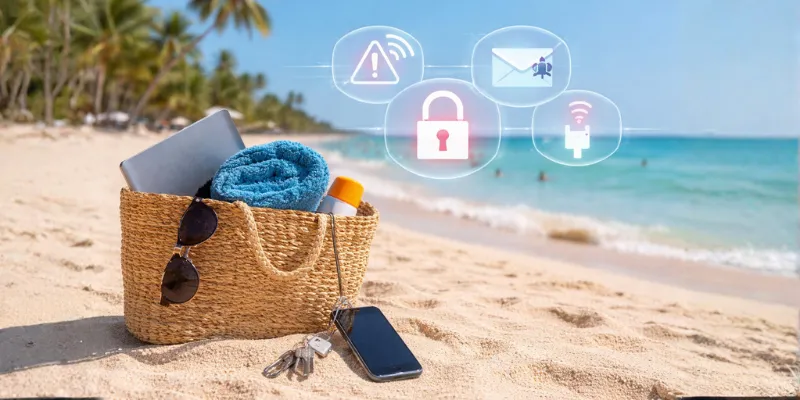
Spring Break Mistakes Don’t Stop After College
Spring break has a reputation for bad decisions, late nights, and stories that usually begin with, “It seemed like a good idea at the time.”
But if you run a business, your version of a spring break mistake probably looks very different, and it usually doesn't involve a beach party or a college campus.
It looks like logging into your email from a hotel lobby. It looks like checking a client request while your family is waiting for you to put your phone down. It looks like connecting to free Wi-Fi because it feels harmless and convenient.
The truth is that most business-related travel mistakes are quiet and subtle. They don't feel reckless in the moment. They feel efficient.
You finally step away for a few days, yet the business does not completely stop. There are still emails coming in, client questions that seem urgent, and team messages that feel important. So you tell yourself you will just handle one quick thing before getting back to vacation mode.
That is usually where the risk begins.
None of these scenarios are dramatic, and that is exactly why they matter. They are small decisions that feel reasonable at the time, but they can quietly expose your systems, your client data, and ultimately your reputation. And if you work in legal, financial, or medical services, you already understand what is at stake.
Client trust is not optional. It is the foundation of your business.
The “Free Wi-Fi” Assumption
When you are traveling, connecting to a hotel, airport, or coffee shop Wi-Fi feels normal, especially when you only need to send a quick message or review a document before breakfast ends.
What many people forget is that public networks are surprisingly easy to spoof. A Wi-Fi network that appears legitimate can be set up by someone nearby who is simply waiting for users to connect. If you log into your email, accounting system, CRM, or client portal while distracted or in a hurry, you may be creating an opening without realizing it.
This is not about fear. It's about awareness and control.
If you need to access sensitive systems, using your phone’s personal hotspot is usually the safer choice. If you must use public Wi-Fi, confirm the exact network name with staff before connecting. These steps may seem small, but they significantly reduce risk.
Leadership is not about eliminating every threat. It is about managing risk intelligently and consistently.
The “Quick Stream” Shortcut
Maybe the hotel television isn't working properly and you want to catch a game, so you search for a free streaming option and click on a site that looks close enough to legitimate.
A few pop-ups appear. Something downloads. You are not completely sure what it was, but the game starts, and you move on.
Many business infections begin this way, not through a sophisticated attack, but through a moment of distraction or convenience. Malware often enters through unsafe downloads, fake streaming sites, or unofficial apps that look real enough.
If a website looks questionable, it probably is. Stick to trusted, official platforms, and close any page that feels suspicious. Missing part of a game is inconvenient. A compromised device connected to your business systems is much more costly.
The “Just Use My Phone” Moment
You hand your phone to your child for a few minutes so you can finish dinner or take a call, and before you know it, new apps are installed, permissions are granted, and subscriptions are activated.
On the surface, it feels minor.
But when that same device contains work email, client communications, financial apps, and multi-factor authentication tools, the situation changes. Your phone is often a gateway into your business environment.
Whenever possible, separate work access from personal devices, use screen time controls, and limit unnecessary app permissions. These are not complicated strategies. They are guardrails, and guardrails protect reputations.
The “I’ll Just Log in Real Quick” Spiral
You open your inbox to clear one message. Then you check your CRM. Then accounting. Then team chat.
Suddenly, you are fully engaged in work mode while sitting on public Wi-Fi, approving multi-factor authentication prompts quickly because you want to get back to your family.
Each login creates a potential exposure point, especially when you are rushing. Before you open another app, pause and ask yourself whether it truly needs to be handled today.
If your business cannot operate for a few days without you reacting from a beach chair, that isn't a vacation issue. It's a systems issue. And systems can be improved.
The “We’re in Cabo” Overshare
Posting vacation photos in real time feels harmless, especially when you are proud of your trip and want to share it.
However, tagging your location and announcing that you will be gone for a week tells the world that your home is empty and you are out of state.
Security is layered. It includes both digital and physical considerations. Posting photos after you return home is a simple way to reduce unnecessary exposure.
The 3 Percent Battery Decision
When your phone battery is nearly dead in an airport, plugging into a public USB charging station seems practical.
Some public charging ports can transfer data as well as power, a risk known as juice jacking. Bringing a portable charger or using your own power adapter keeps control in your hands.
It's a small decision that protects more than you realize.
The Bigger Picture
Most of these mistakes do not happen because someone is careless or irresponsible. They happen because you are balancing multiple roles at once: leader, parent, partner, operator. You are trying to grow your business while managing risk, and that tension never fully disappears.
What I hear most often from business owners across Utah is not ignorance. It is pressure. Pressure to stay secure, compliant, competitive, and efficient all at the same time.
You do not want more tools. You want confidence. You want to know that your client data is secure, your cyber insurance requirements are truly met, and your systems will not fall apart while you are away for a few days.
Real security is not about locking everything down so tightly that no one can function. It is about building strong systems, clear policies, and consistent training so that small travel moments do not turn into major problems.
If you cannot fully unplug without wondering whether something is exposed, the issue is not spring break. It's structure.
When your cybersecurity, remote access controls, password policies, and employee training are aligned and documented, these small decisions stop being threats and start becoming non-events.
That is the goal.
Not perfection. Confidence.
You did not build your business to babysit technology. You built it to serve clients, lead your team, and grow something meaningful. The right systems do more than protect data.
👉 Click here to schedule a quick 26-minute call today and protect your ability to lead with calm, even when you are miles away from the office.
