News
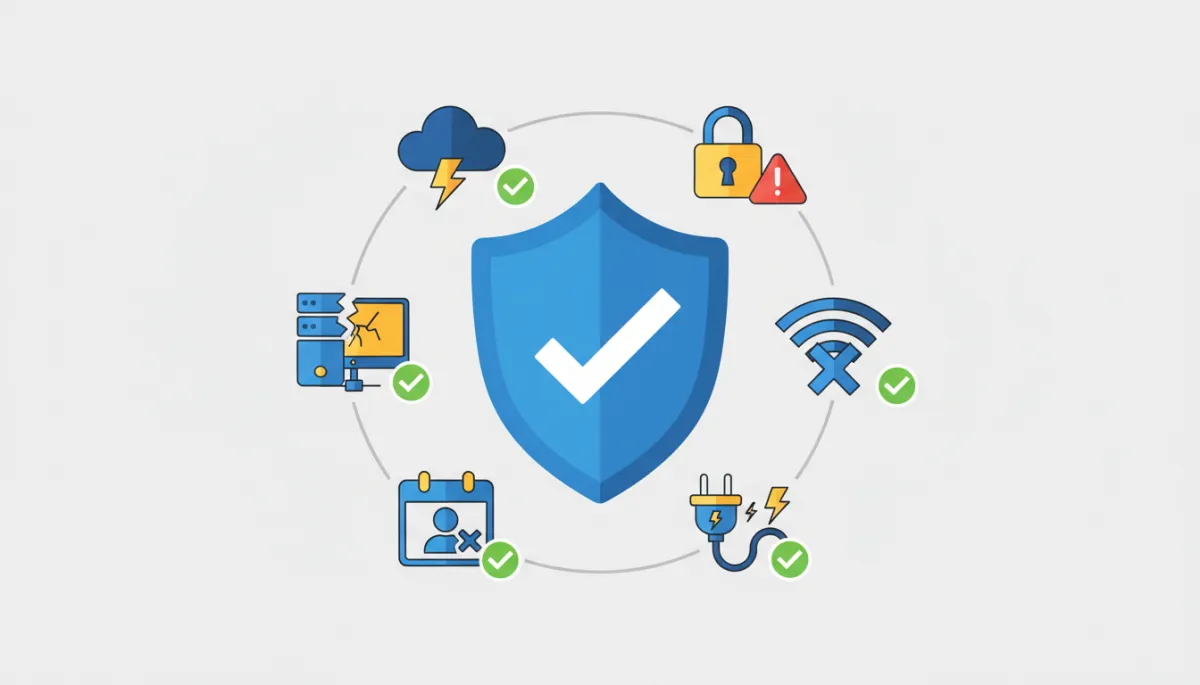
Business Disruptions Are Inevitable. How Prepared Is Your Business? - Copy
Article Summary: Business disruptions rarely arrive with advance notice. A downed internet connection, an absent employee, or a backup that fails at the wrong moment can stop work fast. This guide walks through the most common disruptions small businesses face and explains what practical preparation actually looks like.
Disruptions happen in every business. A downed internet connection cuts off access to customer records. A key employee is suddenly unavailable with no backup in place to cover payroll. Someone deletes the wrong file, and the backup that was supposed to protect against exactly this situation turns out to be months old and completely useless.
None of these look like disasters in the traditional sense, but they stop work, delay customer service, and leave teams searching for answers. The businesses that recover quickly aren't necessarily larger or better-funded than the ones that struggle. They simply had a plan in place before the disruption arrived.
Preparation doesn't require a massive technology budget or a dedicated IT department. It starts with understanding which disruptions are most likely to affect your business and having a clear, practical plan in place for each one.
Cyberattacks and Ransomware
A cyberattack can block your team's access to the files and systems they depend on to do their jobs, sometimes within minutes of the attack beginning. Work stops, customers experience delays, and the pressure to get things back online quickly can lead to decisions that create new problems.
The most practical starting point is building a basic incident response plan before an attack happens. That means deciding in advance who gets contacted first, who has the authority to make key decisions, and which systems need immediate attention. It also means testing your backups on a regular basis, not just setting them up and assuming they'll work. A backup that has never been tested under real conditions is an assumption, not a safety net.
Employee awareness deserves just as much attention as your technical defenses. Cybercriminals regularly target employees because people are often easier to reach than a well-configured system. A suspicious email link, an unsafe attachment, or a stolen login credential can give an attacker everything they need. Making sure your team knows what to watch for and how to report something unusual is one of the most valuable investments a small business can make.
Hardware and Software Failures
Devices and software applications fail without warning, and when they do, your team is stuck waiting. Depending on what went down and how prepared you were, that wait can stretch into hours.
The fundamentals here are consistent: back up your data regularly, document the steps your team should take when something fails (including who to contact), and test your recovery process before you actually need it. A process that exists only on paper but has never been walked through in practice is far less reliable than one your team has actually used.
Human Error
Even careful, experienced employees make mistakes. A file gets deleted, a sensitive email lands in the wrong inbox, or someone adjusts a setting that breaks a critical process downstream. These things happen in every business, and having practical habits in place can significantly limit how much damage a single error causes.
A few of those habits are worth highlighting:
Limit access. Give employees access only to the files and systems they need for their specific role. The fewer opportunities for an error to reach sensitive data, the better.
Document recovery steps. Your team should know who to notify and how to restore a file, setting, or process when something goes wrong. That knowledge shouldn't live only in one person's head.
Train employees regularly. Help your team understand how to handle important data, when to pause and double-check their work, and when to ask for help rather than proceed on their own.
Internet and Cloud Service Outages
When the internet goes down or a cloud service experiences an outage, your team can lose access to customer records, internal communication tools, and core business applications all at once. The disruption can feel total, even when it's temporary.
Having a backup connection available, whether that's a secondary internet line or a reliable mobile hotspot, can keep critical work moving during an outage. It's also worth identifying in advance which tasks your team can handle without internet access and making sure they have what they need to keep that work moving. A clear communication plan that covers how your team stays in touch internally and when customers should be notified prevents confusion from compounding the problem.
Severe Weather and Natural Disasters
Storms, floods, and other weather events can close offices, knock out power, and prevent employees from physically reaching the workplace. Recovery can take hours or days, particularly when backup systems weren't in place in advance.
Remote work capability is one of the most practical protections a business can build. When your employees have the tools, access permissions, and processes they need to work from a different location, a closed office becomes a temporary inconvenience rather than a full operational shutdown. Storing data backups offsite or in the cloud ensures that physical damage to a building doesn't result in permanent data loss. A written business continuity plan that your team has reviewed and knows how to act on ties all of those elements together.
Key Employee Unavailability
This one catches more business owners off guard than almost any other disruption on this list. When the one person who runs payroll, manages a vendor account, or knows the steps to handle a specific client process is suddenly unavailable, work can stall even when everything else is functioning normally.
The answer is straightforward, though it takes intentional effort to build:
Document critical processes. If a task depends entirely on one person's knowledge, write down the steps clearly enough that someone else could follow them. That documentation is operational insurance.
Cross-train your team. Make sure at least one other person knows how to handle the responsibilities that matter most to daily operations.
Manage credentials securely. Store login details and account access information in a secure, approved system rather than relying on one person's memory or personal device.
Build the Plan Before You Need It
You can't predict every outage, failure, or unexpected absence, but you can control how ready your business is when one of those things happens. A plan that exists before a disruption occurs changes the recovery experience entirely. Your team can act with confidence rather than improvise under pressure.
Preparation means replacing uncertainty with a plan your team can rely on. When responsibilities are clearly documented, recovery steps are tested and familiar, and everyone knows their role when something goes wrong, your business responds from a position of readiness rather than confusion.
If you want help preparing your business for any of these disruptions, click here to schedule a quick 26-minute call. We'll help you build a business continuity plan that keeps your business prepared and ready before disruptions occur.
Article FAQs
Q: I have some of these things partially covered. Is that enough, or does every area need a complete plan?
Partial preparation is meaningful, and it's how most businesses build resilience over time. Having a backup in place, even if it hasn't been tested recently, is more than many businesses have. The most important step is identifying which gaps create the greatest risk for your specific situation and addressing those first. A plan doesn't need to cover every scenario perfectly on day one. It just needs to be actionable, documented, and familiar to the people who will use it.
Q: How often should we revisit or update our business continuity plans?
At a minimum, review your plans once a year. That timeline should be moved up any time something significant changes in your business, such as new software, a staffing change, a shift to remote work, or a new location. Plans that aren't reviewed regularly have a way of becoming outdated quickly, and an outdated plan can introduce confusion at exactly the moment when clarity matters most.

FREE GUIDE
Discover The Truth Nobody Is Telling You About IT Security And The New, Critical Threats That WILL Put Your Business At Risk


Answers To Common Questions
Frequently Asked Questions
Do you offer access to senior IT consultants or a vCSO for oversight and guidance?
Yes, we offer access to senior IT consultants and provide vCSO(Virtual Chief Security Officer) as a service for our clients. Our vCSO service provides your organization with expert leadership and strategic direction tailored to your unique cybersecurity and legal compliance needs. We are here to help you navigate the complexities of cybersecurity and ensure that your security posture is robust, compliant, and capable of addressing evolving cyber threats. Book a call today to get expert help with your company’s cybersecurity and compliance.
Do you have a high level of confidence in your security posture? If so, can you explain why?
We have a high level of confidence in the security posture of our company and our clients. Our security stack includes several components to ensure strong and resilient cybersecurity measures. We provide comprehensive risk management, regular audits and assessments, advanced security technologies, employee training and awareness, and incident response planning. Our systems and solutions follow established industry standards and best practices to keep your company safe and your data secure. Since every company has different risks depending on the data, systems, utilization, and more, we can work with your team to develop a robust security plan and implement the proper measures as needed. Reach out today to strengthen your company’s security posture!
Do you have a Disaster Recovery (DR) plan? If so, what’s in place? Is it tested regularly?
We provide robust Disaster Recovery (DR) plans, covering preventative, detective, and corrective measures. Our DR strategies are tailored to each client’s specific needs and are designed to ensure rapid recovery and continuity of operations in the event of any disaster. These plans are regularly reviewed and tested to guarantee they function effectively and meet the highest standards of resilience and reliability. And if a disaster were to occur outside of regular business hours, we have you covered! At qnectU, we have a response time of mere minutes for emergency after-hours calls, ensuring a rapid response to implement your Disaster Recovery plan. Book a call today to protect your company in the event of a disaster.
Do you perform regular risk assessments?
Here at qnectU, we conduct regular risk assessments as a core part of our risk management strategy. Our process is comprehensive, involving identification, categorization, and response planning for potential security risks, including technical vulnerabilities, access controls, and more. These assessments help us understand, control, and mitigate all forms of cyber risk, ensuring that our security measures are effective and up-to-date. But most importantly, we provide continual risk assessments at pre-determined intervals based on your company’s risk level. This ensures that issues are corrected, new risks are identified, and compliance is properly documented. Want to see how our in-depth business risk assessments work? Book a consultation today to get an in-depth risk assessment of your company’s current network security.
Do you follow proven change management principles?
We are committed to following proven change management principles. We understand the importance of structured and systematic processes in implementing changes that affect cybersecurity protocols and IT environments. Our approach is based on industry-recognized frameworks and methodologies that ensure changes are managed effectively, focusing on minimizing risks, enhancing security posture, and achieving strategic objectives.
Do you address all my compliance needs, including HIPAA?
We specialize in Compliance as a Service (CaaS), and our program is designed to meet a wide range of regulatory requirements to ensure that your business adheres to the highest standards of compliance. We demonstrate our compliance through detailed assessments, documentation, and third-party audits. Our expertise and ongoing support can give you confidence that your company’s sensitive information is managed securely and in full compliance with all regulations.
Is third-party auditing provided to ensure cybersecurity and compliance requirements are being met?
In today’s world a business can easily be compromised via a “supply chain hack.” There have been several instances where the IT company has exposed all of their clients to hacking due to their own lack of cybersecurity measures. In order to prevent this within our own company, we work closely with a third party for comprehensive auditing services to ensure that all cybersecurity and compliance requirements are met. Our rigorous audit process involves a thorough examination of our systems and practices against established industry standards and best practices. This collaboration provides an objective perspective and deep expertise to identify any potential vulnerabilities, ensuring that our cybersecurity measures are robust, up-to-date, and in full compliance with regulatory demands.
What is Compliance as a Service (Caas)?
Compliance as a Service (Caas) means that our experts will give you specialized help in handling all the rules and regulations your business needs to follow. We do this by providing expert guidance to help you determine what rules apply to your business and how to follow them. All while giving ongoing support to monitor your compliance status and updates in regulations. This may also include any advanced tools to help manage compliance tasks and risk management surrounding compliance. CaaS takes the hassle out of compliance so you can focus on running your business with confidence.
Who is Greg Mauer?
Gregory Mauer is the founder and CEO of our company, a best-selling author, speaker, and a cybersecurity & compliance expert. He has been on stage with the likes of the “Nice Shark”, Robert Herjavec, Siri co-founder Adam Cheyer, and business coach and author Mike Michalowicz.
Answers To Common Questions
Frequently Asked Questions
Do you offer access to senior IT consultants or a vCSO for oversight and guidance?
Yes, we offer access to senior IT consultants and provide vCSO(Virtual Chief Security Officer) as a service for our clients. Our vCSO service provides your organization with expert leadership and strategic direction tailored to your unique cybersecurity and legal compliance needs. We are here to help you navigate the complexities of cybersecurity and ensure that your security posture is robust, compliant, and capable of addressing evolving cyber threats. Book a call today to get expert help with your company’s cybersecurity and compliance.
Do you have a high level of confidence in your security posture? If so, can you explain why?
We have a high level of confidence in the security posture of our company and our clients. Our security stack includes several components to ensure strong and resilient cybersecurity measures. We provide comprehensive risk management, regular audits and assessments, advanced security technologies, employee training and awareness, and incident response planning. Our systems and solutions follow established industry standards and best practices to keep your company safe and your data secure. Since every company has different risks depending on the data, systems, utilization, and more, we can work with your team to develop a robust security plan and implement the proper measures as needed. Reach out today to strengthen your company’s security posture!
Do you have a Disaster Recovery (DR) plan? If so, what’s in place? Is it tested regularly?
We provide robust Disaster Recovery (DR) plans, covering preventative, detective, and corrective measures. Our DR strategies are tailored to each client’s specific needs and are designed to ensure rapid recovery and continuity of operations in the event of any disaster. These plans are regularly reviewed and tested to guarantee they function effectively and meet the highest standards of resilience and reliability. And if a disaster were to occur outside of regular business hours, we have you covered! At qnectU, we have a response time of mere minutes for emergency after-hours calls, ensuring a rapid response to implement your Disaster Recovery plan. Book a call today to protect your company in the event of a disaster.
Do you perform regular risk assessments?
Here at qnectU, we conduct regular risk assessments as a core part of our risk management strategy. Our process is comprehensive, involving identification, categorization, and response planning for potential security risks, including technical vulnerabilities, access controls, and more. These assessments help us understand, control, and mitigate all forms of cyber risk, ensuring that our security measures are effective and up-to-date. But most importantly, we provide continual risk assessments at pre-determined intervals based on your company’s risk level. This ensures that issues are corrected, new risks are identified, and compliance is properly documented. Want to see how our in-depth business risk assessments work? Book a consultation today to get an in-depth risk assessment of your company’s current network security.
Do you follow proven change management principles?
We are committed to following proven change management principles. We understand the importance of structured and systematic processes in implementing changes that affect cybersecurity protocols and IT environments. Our approach is based on industry-recognized frameworks and methodologies that ensure changes are managed effectively, focusing on minimizing risks, enhancing security posture, and achieving strategic objectives.
Do you address all my compliance needs, including HIPAA?
We specialize in Compliance as a Service (CaaS), and our program is designed to meet a wide range of regulatory requirements to ensure that your business adheres to the highest standards of compliance. We demonstrate our compliance through detailed assessments, documentation, and third-party audits. Our expertise and ongoing support can give you confidence that your company’s sensitive information is managed securely and in full compliance with all regulations.
Is third-party auditing provided to ensure cybersecurity and compliance requirements are being met?
In today’s world a business can easily be compromised via a “supply chain hack.” There have been several instances where the IT company has exposed all of their clients to hacking due to their own lack of cybersecurity measures. In order to prevent this within our own company, we work closely with a third party for comprehensive auditing services to ensure that all cybersecurity and compliance requirements are met. Our rigorous audit process involves a thorough examination of our systems and practices against established industry standards and best practices. This collaboration provides an objective perspective and deep expertise to identify any potential vulnerabilities, ensuring that our cybersecurity measures are robust, up-to-date, and in full compliance with regulatory demands.
What is Compliance as a Service (Caas)?
Compliance as a Service (Caas) means that our experts will give you specialized help in handling all the rules and regulations your business needs to follow. We do this by providing expert guidance to help you determine what rules apply to your business and how to follow them. All while giving ongoing support to monitor your compliance status and updates in regulations. This may also include any advanced tools to help manage compliance tasks and risk management surrounding compliance. CaaS takes the hassle out of compliance so you can focus on running your business with confidence.
Who is Greg Mauer?
Gregory Mauer is the founder and CEO of our company, a best-selling author, speaker, and a cybersecurity & compliance expert. He has been on stage with the likes of the “Nice Shark”, Robert Herjavec, Siri co-founder Adam Cheyer, and business coach and author Mike Michalowicz.
Innovation
Fresh, creative solutions.

Integrity
Honesty and transparency.

Excellence
Top-notch services.
FOLLOW US


Subscribe to our newsletter!
COMPANY
LEGAL
© Copyright 2026 qnectU